
Training explosive strength to level up in basketball
Explosive strength is the neuromuscular system's ability to express high force gradients in the shortest possible time. In basketball it's the quality that decides who gets to the ball first, who goes highest for a rebound and who changes direction without losing a tenth.
Why it counts more here than in other sports
Break down the performance model of basketball and a precise picture emerges:
- It's a situational, intermittent team sport, played at very high intensity
- Explosive strength is baked into the technical movements: bounds, shots, getting free, stops
- Whoever gets to the ball first wins
- The alactic energy system — the one that uses no oxygen and produces no lactate, but only works fully for a few seconds — carries a lot of weight
- The ability to accelerate is fundamental
Just look at the dimensions of the court: to score two points you have to put the ball through a rim set at 3.048 m; to score three you have to shoot from at least 7.25 m.
How you train it: the force-velocity curve
The answer lies in the relationship between load and execution speed:
- The heavier the load (90-95% of 1RM), the lower the speed at which you move the resistance
- The lighter the load (30-40% of 1RM), the higher the speed
Power is force multiplied by velocity, so its maximum sits at neither extreme. That's why the best working percentages are between 20% and 70% of 1RM. Worth remembering: explosive training also trains maximal strength indirectly.
Tools and exercises
The tools you can use:
- Bodyweight
- Barbell
- Box
- Other resistances: rings, rope, bars, parallel bars, medicine balls, kettlebells
The exercises:
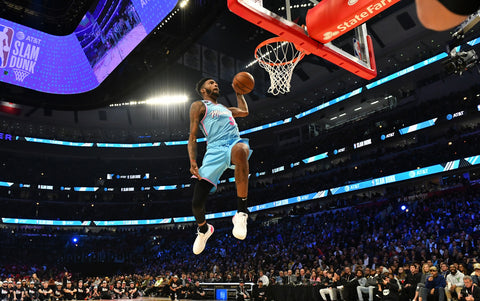
- Technical movements: dunks, shots, accelerations, stops, jumps
- Plyometrics and bounds in every form
- Barbell: squat, deadlift, military press
- Bodyweight: pull-ups, push-ups
- Kettlebell and medicine ball: clean & jerk, snatch, thruster, swing
- Rope
- Sprints, including uphill
- Resistance bands
The four rules you don't break
Whichever route you take, explosive strength training has to respect these principles:
- You train it with compound exercises
- The speed at which you move the resistance has to be maximal — if you slow down, you're no longer training power
- Being a derivative of strength, it needs adequate rest between sets
- You work at low reps
In practice the third one is the most abused: cutting rest to "sweat more" turns a power session into a conditioning session, and the adaptation you're after never arrives.
Explosive strength and maximal strength go together
In modern basketball the speed of play is very high and explosiveness is one of the key elements of preparation. To express it fully you have to train both explosive strength and maximal strength, often in the same session and synergistically: that's the principle contrast training is built on. Neglecting either component means leaving centimeters on the table.
How to know whether it's working
Lower-body explosive strength is measured with the jump. Do the JHP jump test before you start a cycle and redo it after four weeks: it's free, you upload a two-second video and get your vertical in centimeters calculated from flight time. If the number doesn't move, the program needs changing.
➡️ Measure your explosive strength, free
The JHP programs for basketball
Inside the JHP subscription (€99 a year, 13 programs with day-by-day plans, video for every exercise and WhatsApp support) the plans that work on exactly what you've just read are:
- JHP Gym Edition — 16 weeks in the weight room on maximal strength and power (€60)
- The French Contrast Method — heavy strength alternated with explosive movements in the same session (€90)
- Jumping Monster — 14 days of intensive plyometrics, 116 exercises (€40)
- Basket Advanced — the package built for basketball players (€80)
Next step
Explosive strength is measurable. Start there.
Two seconds of video and you have your vertical in centimeters. Free, and the video stays on your phone. Redo the test at the end of the cycle and you'll know whether the work paid off.
Measure your jump — free JHP subscription — €99/yearJust the basketball package? Basket Advanced, €80.
You might also like: how high NBA players jump and contrast training for a higher vertical jump.
