
How do you tell if your vertical jump is improving?
To know whether your jump is improving you have to measure it with the same test, under the same conditions, before and after a training block. Switching tests between one measurement and the next is the fastest way to fool yourself: every protocol measures something different.
Below you'll find the six most used tests, what each one measures, and how to get a reliable number without buying national-team-level equipment.
Sargent test
The simplest and most common. The athlete stands side-on to a wall, reaches all the way up with arm and hand fully extended and marks the height of the fingertips. Then bends the knees, jumps off both feet and chalks the highest point reached.
The gap between the two marks is the vertical, meaning the explosive and elastic strength of the lower body. It's free, but the accuracy depends entirely on how good you are at marking the point while you're in the air.

Counter Movement Jump (CMJ)
A jump with a countermovement: you use the elastic force the muscles generate during the eccentric phase on the way down to get more power in the concentric push.
It's the test closest to what you actually do on court, because at the block or on attack you always start with a countermovement.

Squat Jump
You start from a half squat, knees at 90°, hands on your hips, and jump as high as you can with no countermovement. By removing the elastic component, the test isolates pure concentric strength.
Comparing the Squat Jump and the CMJ is useful: if the gap between the two is small, your problem isn't strength but the ability to use the elastic component. If it's large, you're short on base strength.

Drop Jump
You step off a box and, the instant you touch the ground, do a vertical jump as fast as you can. The box height should be picked based on the athlete's level, not on how brave they feel.
It measures reactivity: how little time you spend in contact with the ground. It's the test closest to a one-foot takeoff.

Abalakov test
The athlete wears a belt with a centimeter tape running through a buckle. The tape shows the difference between the starting measurement and the one reached with the jump, done off both feet from a static position. Unlike the others, here you're free to use your arms.

Vertec Jump Test
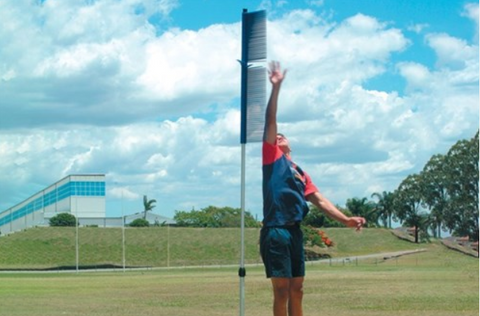
Used mostly in the US, it's the pole with the swivel vanes you see at combines: you jump and swat the vanes at the peak of the jump.
The downside is that the result is affected by how you execute the jump: drift too far forward, backward or sideways and the number changes.
What you measure it with
Vertical jump measurement is done with contact mats, accelerometers, infrared platforms, high-speed cameras and force plates.
A widely used one is the Bosco mat, which works out the height from how long the athlete stays in the air. It's the same free-fall physics: the longer you're up there, the higher you went.
The problem with all of these is that they cost money and you don't have access to them. And filming yourself and eyeballing it isn't a measurement: it's an impression.
Measuring your jump online, for free
The JHP jump test applies the contact mat method to the frames from your phone: it counts flight time frame by frame and works out the height in centimeters.
How it works:
- Upload a video of your jump, two seconds is enough
- Mark the moment your feet leave the ground and the moment they land
- Hit the button and read the result
It's free, no app needed, the analysis runs inside your browser — so the video never leaves your device — and the page states the margin of error alongside the number.
➡️ Upload your video and get the result

The three rules for comparable numbers
- Same test, always. Don't compare a CMJ with a squat jump: they measure different things.
- Same conditions. Same shoes, same surface, same time of day, and always when you're fresh — never at the end of a session.
- Three attempts, keep the best. A single jump can go wrong for a thousand reasons.
Every four weeks is the right rhythm: it's the minimum time for a block to produce measurable adaptations, and it's short enough that you'll notice if a program isn't working.
Then you train
The test tells you where you are, not how to improve. The JHP subscription gives you 13 programs with day-by-day plans, a video for every exercise and WhatsApp support, for €99 a year:
- Jump Higher Program — 10 weeks of bodyweight jump training (€60)
- JHP Gym Edition — 16 weeks in the weight room on maximal strength (€60)
- Jumping Monster — 14 days of intensive plyometrics, useful if reactivity is your weak point (€40)
- The French Contrast Method — heavy strength alternated with explosive movements (€90)
Next step
The best test is the one you'll actually repeat.
Force plates and Vertecs are accurate but you don't have one. Two seconds of video you do have, and you can repeat it every four weeks without asking anyone for anything.
Measure your jump — free JHP subscription — €99/yearYou might also like: the elastic explosive strength rating tables and the exercises to jump higher.
