
Stretching in volleyball: better performance and fewer injuries
Stretching is useful for a volleyball player, but not at the moment most of us do it. Before a match you need a dynamic warm-up, not long static holds: prolonged static stretching before an explosive effort can temporarily reduce strength and jump height. Lengthening and mobility work pays off far more after training or in dedicated sessions, away from performance.
Below you'll find what stretching is, what types exist, what it really does and what it doesn't, and a sequence of exercises to do at the end of a session.
What stretching is
The name says exactly what it does: to stretch, to lengthen. It's a method that works on muscle lengthening and joint mobilisation, through stretching exercises of varying complexity.
Stretching exercises don't only load the muscle fibres, they also load the connective tissue — tendons, fascia, sheaths — that wraps and connects the contractile structure. Connective tissue is extensible, but if you don't work it regularly it tends to lose that quality.
Where it comes from
Stretching practices have ancient, Eastern roots: in Indian yoga and in Chinese traditions, work on the body and the breath has been documented for thousands of years. The modern, codified version we know in the West spread much later, on the wave of gymnastics and fitness culture, and owes a lot to the work of Bob Anderson and his stretching manual.
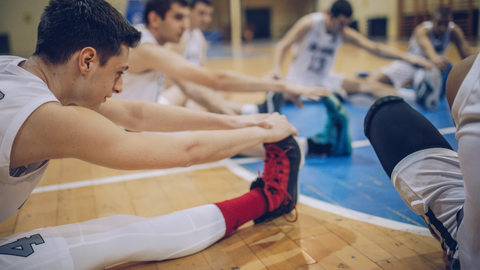
Joint mobility for a volleyball player
Joint mobility is the ability to move through wide ranges, up to the maximum physiological range the joint allows. It depends on:
- the bone structure of the joint;
- how extensible ligaments, tendons and muscles are;
- the ambient temperature;
- how warmed up the body is;
- habit: fibres adapt fast, for better and for worse.
If you play volleyball, three areas matter most:
- Ankle — a stiff ankle limits how deep you can squat and shifts load onto the knee when you land.
- Hip — you need it for low defence and for an effective approach.
- Shoulder and thoracic spine — the arm in attack and in serve demands range: if the thoracic spine doesn't rotate, the shoulder compensates.
What stretching really does (and what it doesn't)
This calls for technical honesty, because stretching comes with promises that practice doesn't keep.
What it's reasonable to expect
- More joint range: this is the most solid and most repeatable effect. Do it consistently and you move through a wider range.
- Less perceived stiffness: especially the day after heavy sessions.
- Better movement control, if you pair it with active work in the new range: mobility you can't control is no use on court.
- A mental wind-down: ten minutes at the end of a session help you close out training and slow down.
What not to expect
- It's not a painkiller for DOMS: next-day soreness doesn't go away by stretching.
- It's not a guarantee against injury: what cuts the risk most is strength work, eccentric in particular, and landing control.
- Don't do it static and long right before you attack: it can temporarily reduce your strength output. Before a match you need dynamic mobility, activation and progressive jumps.
When to do it, in practice
- Before training: dynamic warm-up. Controlled swings, walking lunges, hip and thoracic mobility, running drills, then jumps at increasing intensity.
- After training: longer, calmer holds on the areas you worked, 30-60 seconds per position.
- In a dedicated session: one or two days a week, on your lighter days. This is where mobility really improves.
The types of stretching
- Static — you reach the stretched position slowly and hold it. It's the most common one and the best fit after training.
- Dynamic — controlled swings of arms and legs that gradually take you to the edge of your range, with no jerking. This is the warm-up one.
- Ballistic — fast, rhythmic movements with bouncing, using speed as the driving force. Not a great fit for most amateur athletes.
- Passive — the stretch is produced by an external force: a tool, a training partner or a physio. Typical of rehab work.
- Active — you reach and hold the position yourself by contracting the antagonist muscles, with no outside help.
- Global active — works on whole muscle chains instead of single muscles, with postural goals too.
- Isometric (PNF) — alternates stretching and isometric contraction of the muscle being stretched. Keep the contraction moderate, otherwise the effect is toning rather than lengthening.

Five exercises for the end of a session
Hold each position between 30 and 60 seconds, breathing. You should feel tension, not pain: if you're gritting your teeth, you've gone too far.
- Standing quad — grab your foot and bring it towards your glute, torso upright, no arch in the lower back.
- Seated hamstring, leg open — one leg out to the side, the other bent inwards. Bring your chest towards the straight leg, reaching for your toes, knee straight and back long.
- Seated posterior chain — legs straight out in front, fold from the hips as you breathe out, no yanking, bringing your chest towards your thighs.
- Triceps and shoulder — arm up, elbow bent behind your head, grab the elbow with the opposite hand and guide it back, without forcing.
- Lower-back rotation, lying down — one leg bent to 90° taken across the other, shoulders on the floor, straight leg still.
Add ankle mobility (knee to wall) if you play middle or attack a lot: it's the joint that stiffens up first.
Music and routine
This isn't a pointless detail: having a fixed playlist for your stretching session helps you actually do it, because it turns ten easy-to-skip minutes into a routine you recognise. You want slow music, long enough to cover the session.
First you measure, then you train, then you measure again
Mobility on its own won't make you jump higher: it puts you in a position to train better. The centimetres come from work on strength, speed and elasticity, repeated over weeks.
To know whether it's working you need a number. The free jump test asks for a two-second video and gives you the height in centimetres, calculated from flight time. The video never leaves your device. Measure today, repeat in a few weeks, compare.
JHP programs on mobility and jumping
- The Stretching Bible — over 50 stretching and mobility exercises, €20. It's the program closest to this article.
- Jump Higher Program — 10 weeks of bodyweight jump training, €60.
- Knee Power — knee strengthening and jumper's knee, €40.
- Volley In-Season Workout — 16 weeks across pre-season and in-season, €90.
With the JHP subscription you get 13 programs for €99/year, with WhatsApp support and cancel anytime. Otherwise you can find all the courses to buy one by one.

What's next
More mobile, sure. But are you jumping higher?
Stretching improves how you move, not how high you take off. Get your starting number from a two-second video and measure again after a few weeks of work: that comparison is what tells you whether the program is working.
Measure your jump — free JHP subscription — €99/yearJust the stretching part: The Stretching Bible, over 50 exercises, €20.
You might also like: Resistance band stretching: the most effective exercises · Knee pain in volleyball: jumper's knee

1 comment
utile